
Add products by adding codes
RS232/RS485 Hubs, Converters, and Repeaters – Complete Guide
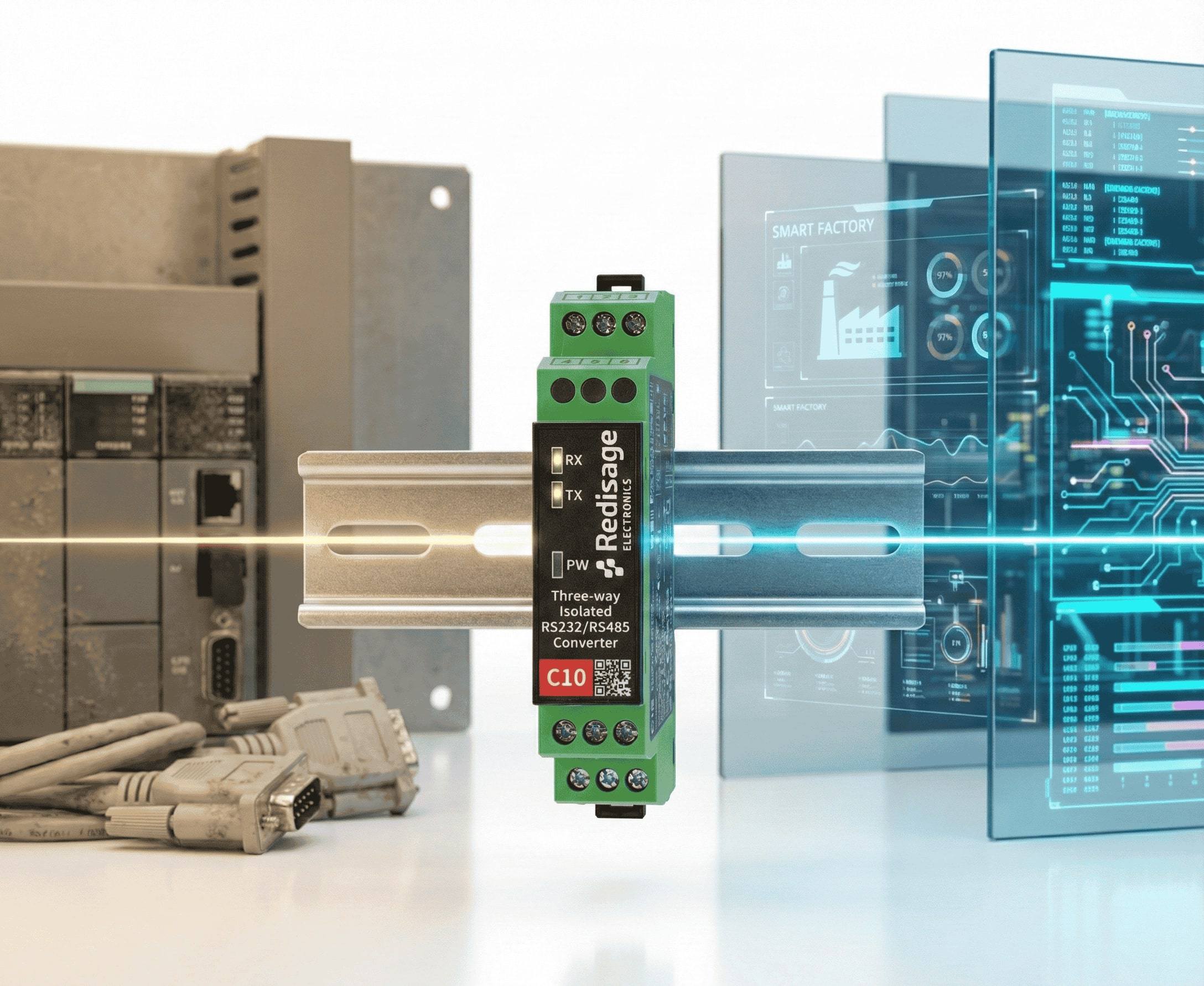
RS232/RS485 Hubs, Converters, and Repeaters – A Complete Guide
Wondering how to connect modern systems with classic automation? Despite the dominance of Ethernet, RS232 and RS485 interfaces remain the backbone of many industrial installations. Learn how to effectively integrate systems, eliminate interference, and extend transmission range using professional hubs, converters, and repeaters.
Why Do We Still Use RS232 and RS485 in the Age of Ethernet?
It might seem that protocols like PROFINET or EtherCAT have replaced old standards. However, the reality in factories and control cabinets is different. Traditional serial interfaces remain indispensable for several reasons:
- Device Standard: Many PLCs, energy meters, inverters, and I/O modules still feature built-in RS232/RS485 ports as their primary communication channel.
- Edge Computing Reliability: In simple Edge applications where simplicity, ruggedness, and low implementation costs matter, serial communication often wins over IP networks.
- Ease of Integration: There is often a need to quickly connect legacy machinery with new infrastructure without replacing the entire machine park.
However, for these systems to operate stably in a modern, noisy environment, we need intermediary devices: hubs, converters, and repeaters. Below, we discuss how to select them for your application.
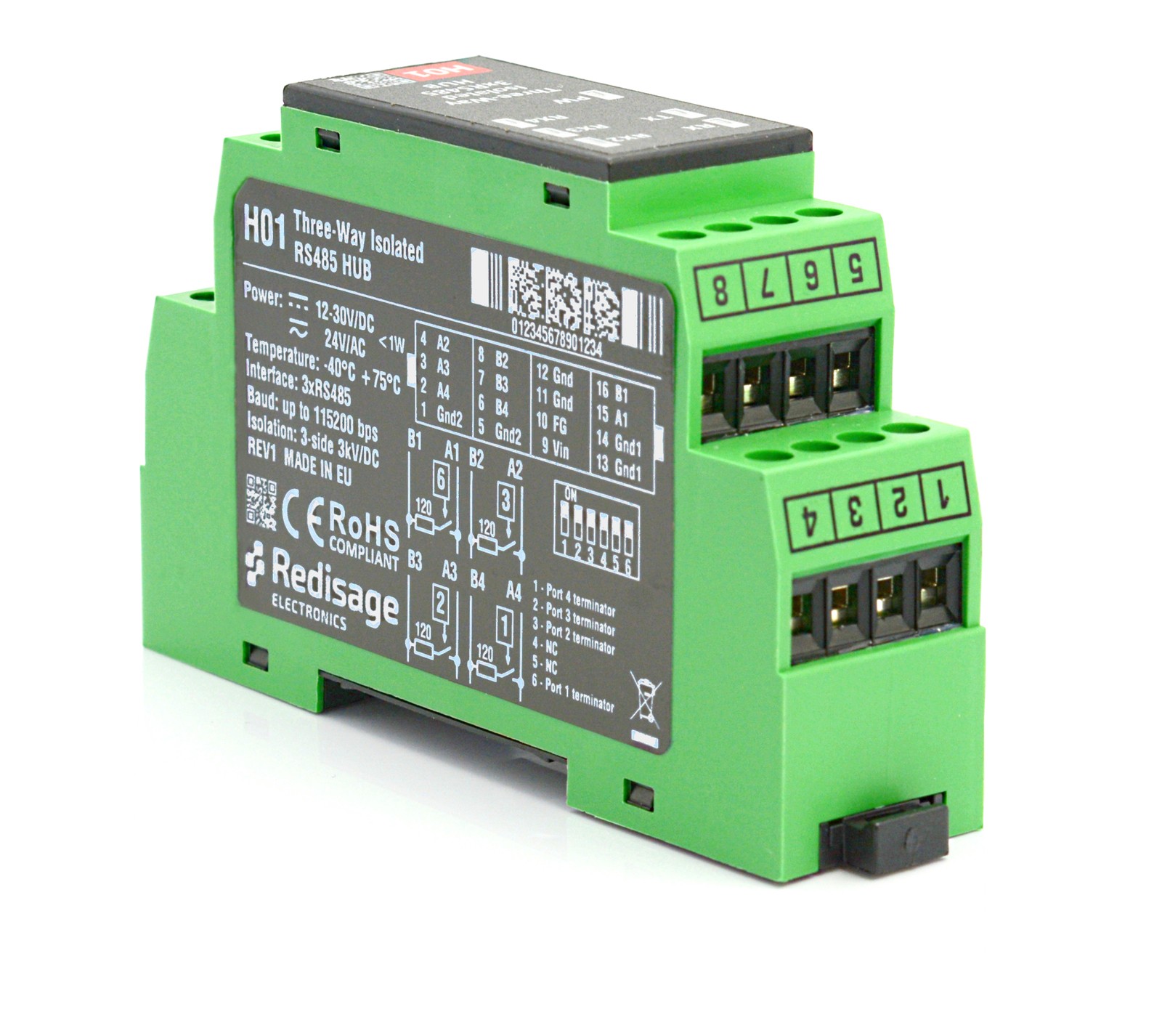
RS485 HUB – What Is It and When to Use It?
How Does an RS485 Hub (Active Splitter) Work?
In simple terms, an RS485 hub is a device that splits a single bus into several independent branches (star topology). It works on a 1 -> N basis (e.g., one input port to three output ports).
Unlike simple cable bridging, a professional hub (such as those in the Redisage offer, e.g., models H01, H02, H03) performs three key functions:
- Galvanic Isolation: Protects the main controller from surges that may occur on individual branches (isolation up to 3 kV DC).
- Signal Regeneration: Each output port boosts the signal, allowing for the construction of more extensive networks without data loss.
- Short-Circuit Detection: A failure on one branch does not paralyze the entire network – the hub isolates the damaged segment.
When Should You Implement an RS485 Hub?
- When you need to create a star topology (which is normally not recommended for pure RS485).
- When you want to separate different zones of a machine or production hall.
- To facilitate diagnostics – it is easier to find a fault in one of 3 separated branches than in a single 1000-meter bus.
Tip: Redisage hubs feature Three-Way Isolation and are designed for DIN rail mounting, saving space in the control cabinet.
RS232 to RS485 Converters – Bridging Standards
Why Do You Need a Converter?
RS232 and RS485 are two different physical worlds. An RS232 <-> RS485 converter is essential when you want to connect a legacy device (e.g., a scale, barcode reader) to a plant-wide RS485 bus.
- RS232: Point-to-point interface, short range (up to 15 m), susceptible to interference.
- RS485: Differential interface, huge range (up to 1200 m), resistant to interference, supports multiple devices.
Redisage offers C10, C11, C12 series converters featuring 3 kV isolation. Example: The C10 model (Three-way isolated converter) handles both sides as fully separated.
Key Applications for Converters:
- Range Extension: Converting RS232 to RS485 allows data transmission over a kilometer.
- Multi-point Network: Enables integrating a 1:1 device into a Master-Slave network.
- COM Port Protection: Thanks to isolation, you protect the computer/PLC port from voltage spikes on the line.
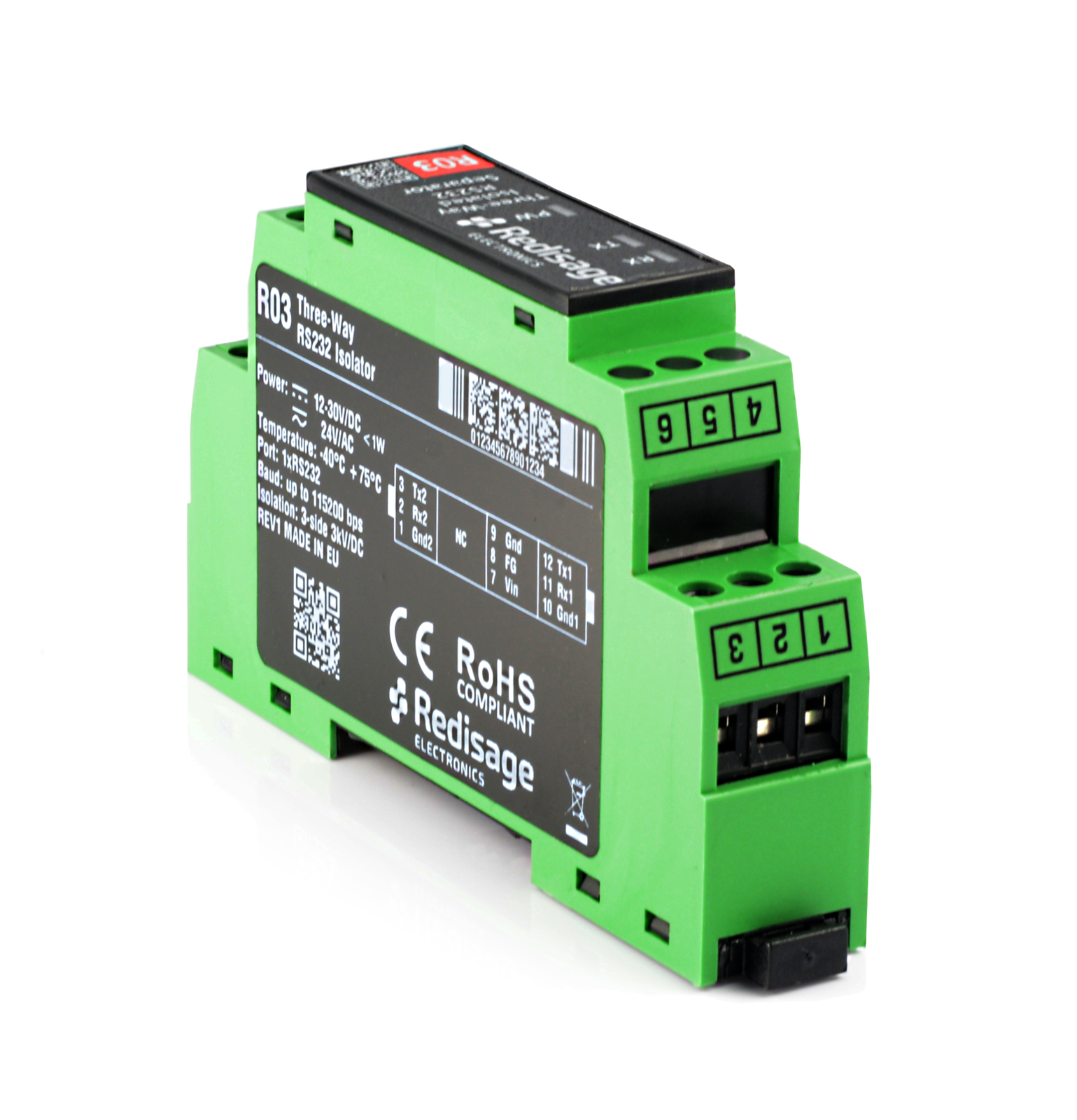
RS485/RS232 Repeaters – How to Boost the Signal?
What Does a Repeater Do?
Electrical signals weaken with cable length. A repeater receives the weakened signal, "cleans" it, amplifies it, and transmits it further at full power.
- For RS485 (Model R01): Allows crossing the 1200-meter barrier or handling more than 32 devices.
- For RS232 (Model R03): Allows extending a standard connection beyond the 15-meter limit.
When to Use a Repeater?
- When your RS485 network is unstable at the ends of long lines.
- When you need to connect two network segments with different ground potentials (isolator function).
- When exceeding the maximum number of devices in a single network segment.
How to Select Devices for Specific Industrial Applications?
Below are recommendations and tips to keep in mind during the design process:
| Parameter / Challenge | What to Look For | Why It Matters |
|---|---|---|
| Transmission Distance | Check max range (relative to baud rate). | Higher speeds mean shorter range without amplification or a repeater. |
| Number of Devices / Nodes | Max number of nodes on the bus, topology. | In RS485 networks, the limit is often 32 devices per segment. |
| Electromagnetic Interference (EMI) | Galvanic isolation, shielding, filters. | In noisy environments, equipment protection and signal quality are crucial. |
| Communication Type (Half-Duplex / Full-Duplex) | Choose devices supporting automatic direction control (for half-duplex). | Simplifies implementation and avoids data collisions. |
| Temperature & Environment | Temperature range, mechanical resistance. | Devices must operate in the harsh conditions of a control cabinet or in the field. |
| Power Supply | Voltage range, redundancy, DIN rails. | Automation systems often have limited or specific power supplies. |
| Mechanical Compatibility | DIN mounting, module width, connection method. | In tight cabinets, mechanical errors are easy to make. |
Summary and Recommendations
- RS485 Hub is a great solution when you want to split the bus into multiple branches, offload the network, or apply isolation between segments. For this, our H01-H03 devices will be the best fit.
- RS232 <-> RS485 Converters enable the integration of devices with the old RS232 interface into modern RS485 networks, as well as transmission extension and isolation. For this application, the C10-C13 converters are perfectly suitable.
- Repeaters (for RS232 / RS485) help in extending lines, regenerating signals, and connecting segments, which is especially valuable in large installations. To this task, we recommend using our R01-R03 modules.
The keys in typical industrial automation systems are: galvanic isolation (preferably 3 kV or more), temperature resistance, DIN rail mounting, and modularity/flexibility in configuration (speeds, transmission directions, number of ports).
Recommended

C10 - RS232 to RS485 Converter (3-Way 3kV Isolation)

C12 - RS232 to RS485 Converter (Isolation on RS485 Side)

C11 - RS232 to RS485 Converter (Isolation on RS232 Side)


